|
. |
|||
|
AMERICAN CINEMA PAPERS
2010
|
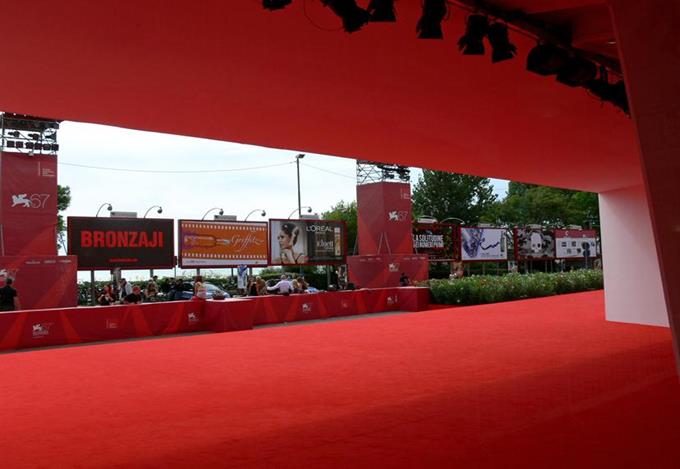
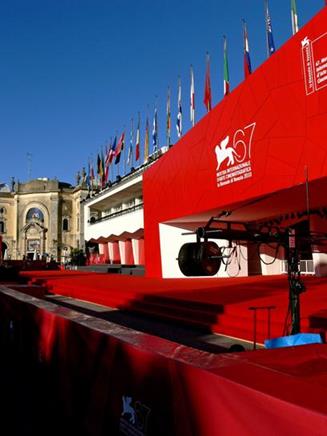
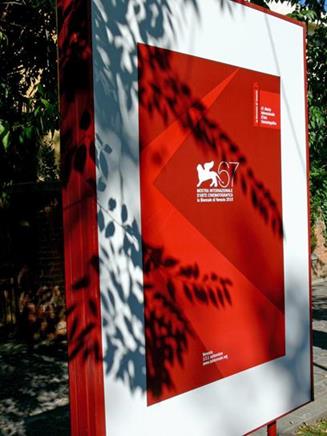
VENICE 2010 – THE 67 th MOSTRA
DEL CINEMA THE WIND AND THE LION by
Harlan Kennedy
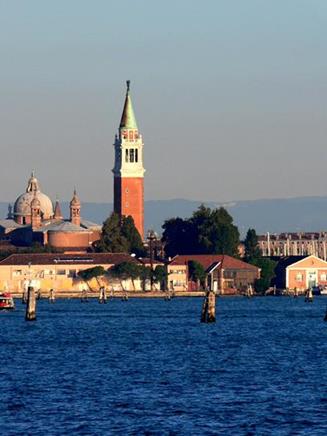
Winds howling across the
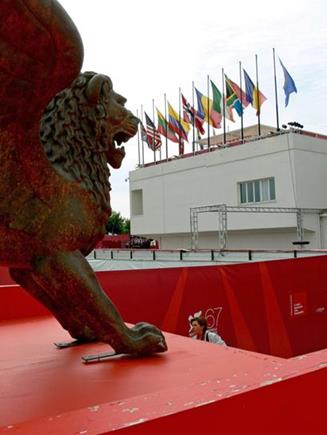
lagoon. Lion statues tumbling down steps. Festival officials tossed about
like balloons. (Isn’t that Marco Mueller himself, Mostra
del Cinema chief, flying over a roof?) Rain descending like giant combs to
sleek and slick the hair of hurricane-lashed trees. We knew the 2010 Venice
Film Festival would close with a
tempest. Julie Taymor’s film of Shakespeare’s play,
starring Helen Mirren as a female Prospero, was the scheduled last-night
gala. We didn’t know a tempest would begin the event. But how great to be on
an Adriatic island when hell breaks loose. Action, spectacle, elemental
music. You think you have died and gone to a Cecil B DeMille
movie, laid on as a billion-dollar film
sorpresa at the Mostra
del Paradiso. This was the year
Mueller said everything would be different. For a start there were three
opening films, not one. On the first night the Palazzo Grande audience –
nobs, toffs and designer-dressed signorinas – sat
white-knuckled through a trio of thrillers: Darren Aronofsky’s
BLACK SWAN (blood at the ballet), Andrew Lau’s LEGEND OF THE FIST (punch-ups
in Peking) and Robert Rodriguez and Ethan Maniquis’s
MACHETE (gore galore, siphoned off from RR’s spoof trailer from GRINDHOUSE).
The evening of harum-scarum entertainment was planned to illustrate Mueller’s
newest pronouncement on movies: something about a “contract between the
filmmaker and his audience,” ignoring or combining genre differences, from
which the audience emerges shaken and stirred while the filmmaker, like a
barista making a good cocktail, takes the compliments and the money. Ah Venice. It’s always
different. Not just from year to year but from day to day. The clouds had
barely drawn back on the morrow to reveal the usual blue skies when we were
in art business as usual. Three pics from around the globe qualified as best in fest.
They came, in order of projection, from Japan, Russia and China. They each –
you could say if you were looking for a tema della mostra (theme
of the festival) – explored the potential drama and communicability of inner
states or esoteric ambiences. Not excepting, indeed
distinctly highlighting, the realm of death. NORWEGIAN WOOD. Tran Anh Hung from Vietnam, a former Venice Golden Lion winner
(CYCLO), is the helmer entrusted with Japanese
novelist Haruki Murakami’s international
bestseller. It’s been read in 30 languages. It’s got a Beatles song for a
title. (We’re in the 1960s). Yet its tale of suicide, depression and wayward
love, clumsily handled, could have sent world audiences screaming to the exit
doors. Watanabe, the hero-narrator, loves two women, the depressive Naoko and
the life-loving Midori. He tries to juggle the romantic tasks but finds them,
if anything, juggling him, The novel was full of
antic, anguished mood changes elegised by recall. Tran, directing, finds a
screen style to suit. Images of nature – mainly the grasslands and mountainscapes around Naoko’s mental convalescence
retreat – have an animistic power (wind, rain, changing colours, fluctuating
textures) while the humans seem transfixed each by his own, or her own,
comedy or tragedy. Hypnotic at its best, the film has a starmaking
performance from model-turned-actress Kiko Mizuhara, whose Midori, combing
the wilful and wistful, is Murakami’s character to the life. OSVYANKI
(SILENT SOULS). Russian cinema is unbeatable for tales of epiphany at the edge of the
world. See its last Golden Lion winner, Andrei Zvyagintsev’s
THE RETURN. Alexei Fedorchenko’s film unfolds in a Finno-Russian remoteness, where the old ways cling on
surreally, decayingly, like the snaky pontoon
bridges, crumbling factories, desolate highways. This is the land of
torch-lit midnight atavism. The land of what seems to us a social-historical
trance state. Are we really in a community, the ‘Merjans’,
where a widowered spouse, such as the factory boss
friend of the hero (a paper-mill worker and amateur
cartographer/ethnographer), whose wife has died, takes his deceased partner
to a beach and burns her on a pyre? Before that he and the hero hand-wash the
woman’s body and tie ribbons to her pubic hair. It’s a tribal tradition. The
surviving mate also reminisces aloud – it’s called ‘smoking’ – about his
bygone sex life. “All three of her holes were working and I unsealed them.”
Crikey. This is Russia? Politically
and socially repressed for the last 100 years? The film is spellbinding, like
a wound reopened so the air can reach it and friendly animals can lick it.
Bereavement, and Russia, with a human dimension. THE DITCH. Now we go to
China. Wang Bin’s movie, sprung on us as this year’s film sorpresa, is a gruelling account
of a re-education camp in the Gobi Desert. Time: 1960. They weren’t listening
to Beatles’ songs back then. If they had been, it would be ‘A Hard Day’s
Night.’ That’s what life was. Hard labour under a searing sun, shivering
sleep (or more labour) under a cold moon. The men bunked – according to this
film based on documents and survivors’ accounts – in rat-infested dugouts,
hence the title. People became corpses and were carried out, trussed in their
last blanket. Food was rat soup, seeds scrabbled from the desert or sometimes
– look away now – the best-looking bits from your friend’s vomit. Wang Bin
can’t quite sustain the cold horror. A midsection with a bereaved wife
seeking a vanished (and, we learn, cannibalised) husband seems routine: just
tears, wailing, agony, despair. The real unbearability of this story is the way the doomed men
just get on with it. Eating the uneatable; remembering things too painful to
remember (like freedom); watching their own souls, minds and bodies shuffle
forward in the queue for death. A new Russia? A new
China? Countries which can produce films like these, candid, countercultural,
counter-revolutionary? Human? Holistic? Which is to say,
complete in the understanding of the holes humans dig for themselves – and
must then find ways to transcend or escape. The Venice Film Festival
had its own hole. Its own ‘ditch.’ Its own quarried habitation for the
sighing of silent souls. I mean the building site where the new festival
palace is going up. Or would be if the project weren’t going over-schedule.
The latest delay to a building planned for inauguration next year is the
discovery of an asbestos burial site. Yes, it’s a toxic
Mycenae. Festivalgoers skirt the bio-hazard, as large as a necropolis, and
marvel as they circumambulate at the traces of pink
and pillared ruin on the excavated sides. Great gods and little caryatids,
were temples once here? Or sacrificial shrines? Or an ancient forum?
Everywhere you go in Italy, or everywhere you dig, seems to turn into history
and romance. FELLINI ROMA Part 2, Part 3, Part 4…. Dangerous too. This
year, if you opened the wrong door to flee a bad movie – and there were a few
– you could fall straight into the giant hole. Down you plunged, to where
asbestos-formed monsters, retired festival directors, or old corpses of
Venetian doges, embraced you slitheringly or tried
to drag you deeper down, perhaps to hell itself, which in this abyss is one
floor down after ancient kitchenware, lost digging tools and broken Roman
pottery. Fear not. These were
only dreams or nightmares. Fest boss Mueller, dressed in black, went about
reassuring us the hole would be a
palace one day. La Cenerentola (Cinders) will go to the ball. Meanwhile happy
times were available this year watching, for instance, that wild notion of
Marco’s for an opening triple bill: the noblest men and women, in their
finery, splashed with blood from seven to midnight. Marco has only one year
left of his second four-year contract. Was this a farewell Walpurgisnacht? Or a phantom-of-the-palazzo gig from
a man who dreams of staying on as a spirit to dash about the Lido kinos and haunt their rafters, in future Mostras, now and then dropping a memory like a giant
chandelier? Marco has a good record:
let it be taken into account. And though the 2010 Venice festival was not his
finest, count the number of talking-point movies. The prattling classes had a
lot to say about Abdellatif Kechiche’s
VENUS NOIRE, for instance, closely followed by Jerzy Skolimowski’s
ESSENTIAL KILLING and Pablo Larrain’s POST MORTEM. VENUS NOIRE re-enacts
the true history of the Hottentot Venus, the African woman whose stupendous
attributes – including prominent posterior and protrusive pudenda – became
the craze of Europe in the early 19th century. She was a circus
star, salon celebrity and curio for anthropologists. Finally, when luck
waned, or so claims writer-director Kechiche (whose
last movie was another provocateur tale of ethnic collision, COUSCOUS), she
was a sex worker satisfying men who liked it racially mixed. At 2 hours 40 minutes,
little is left unsaid about race and gender attitudes two centuries ago –
about prejudice and prurience – and much of it is said fortissimo Andre Jacob and Olivier Gourmet, playing the
consecutive masters of ‘Venus’ (real name Saartjie Baartman), shout their dialogue to the rooftops. Down in
the bearpits of what passed for society, in London
and Paris, the baying toffs prod and paw the poor girl – to the point where
Venice audiences said Kechiche was exploiting his
actress, Yahima Torres, in the same way the world
of 1810 exploited Saartje. You pays
your Euro and you forms your verdict. Me? I thought the film’s fault was not
its complicity in the voyeurism it purports to condemn, but rather the
lecturing, hectoring tone. At shorter, more teasing length it could have genuinely allowed the filmgoer to
think for himself, instead of suspecting he was being mugged by an
ideological highwayman saying, “Your agreement or your life.” ESSENTIAL KILLING is a
skilful manhunt flick about an escaped Afghan jihadist (Vincent Gallo),
pounding the Polish snows as he flees men depicted as CIA torture-transit
goons. Skolimowski evidently went nutty in the
editing room: the 83-minute story contains lacunae and non-sequiturs. (How did the protagonist replace his torn
and ratty prisoner threads with that handsome, perfectly fitting white
jumpsuit he suddenly wears in a new scene?) But at least we are posed an
interesting question. Can an adventure story, confidently told, get us
rooting for the last person on earth with whom we’d normally identify? POST MORTEM is about
sex, autopsy and the corpse of Salvador Allende. Chilean director Pablo Larrain made the morbidly brilliant TONY MANERO, a
SATURDAY NIGHT FEVER riff whose protagonist had a white suit and diseased
mind. Actor Alfredo Castro – mouldering pallor, shoulder-length hair –
returns as a mortuary scribe, taking down autopsy details until the day the
assassinated President appears before him on a slab. Place: Santiago. Year:
1973. What effect will this sudden drafting into political history have on
the hero’s creepy love life? His ex-stripper girlfriend, caught up with
dissidents, is hiding behind a wall in his house. How long will she stay
there….? Yes, creepy is the word. Larrain has
cornered a part of the movie market where the meat starts to stink a little.
For low prices – his films look as if they cost almost nothing – he will sell
you something with the unforgettable odour of mortality, and sometimes as
here, a spice of wit, even wisdom. The weakest films at
Venice went to the wall, in quite a different sense – or perhaps not – from
the heroine of POST MORTEM. Personally, I would like to wall up alive Sofia Coppola’s SOMEWHERE. Or to bonfire as a vanity
this LA-set variant on SC’s LOST IN TRANSLATION. Where Scarlett Johansson and
Bill Murray marooned in a Japanese hotel were magic, Stephen Dorff as a spoiled film star and Elle Fanning as his
estranged teen-brat daughter stuck at the Chateau Marmont
are not. Too much like Lalaland realism: the truth
at 24 narcissistic whinges a second. Julian Schnabel’s MIRAL
is one man’s UN-style statement about how Israel and Palestine should live
together in an ideal world. Unfortunately Shnabel’s
ideal world appears to consist of bimbo casting (the vapidly decorative Yasmine al Massri as the
orphan-of-discord heroine), bumper-sticker dialogue and the kind of flatulent
liberal generalities that gave Stanley Kramer’s cinema a bad name. Better, if not by a
mile, was Tom Tykwer’s THREE, an infidelity
drama-comedy that breezes along until we realise the man and woman two-timing
each other are doing it with the same guy. German cinema is crazy for this
kind of polysexual screwball romp. She gets
horny-hetero, he gets horny-gay and the cynosure of their desire is a
baby-faced stem-cell scientist who looks like a Botoxed
Gordon Ramsay. Weird. There’s a biological-philosophical idea – none too
convincing – that human sexuality is really a blank cheque (like a stem-cell)
that gets filled in by volition not destiny. Hmmm. As a partner-swapping
romp, it was at least better than Anthony Cordier’s
HAPPY FEW, a swingers’ rondo from France and by pretty general consent the
worst movie in concorso. Never mind! Whenever we thought all
was lost at the 67th Venice Film Festival, winners blew in like
tumbleweed. They might be slender, might be modest, but they indicated life
and growth in the desert. Among small pleasures my favourites included
Patrick Keiller’s ROBINSON IN RUINS and Kelly Reichardt’s MEEK’S CUTOFF. The first is a British
pastoral documentary – how else describe it? – from
a filmmaker whose past works (LONDON, ROBINSON IN SPACE) teasingly trace
social/cultural/economic history in the curves and tilth
of the UK countryside. Sometimes Keiller is drily
authoritative, at others a seriocomical tease.
‘Robinson’ is his unseen protagonist, a German-born agro-boffin supposedly
cast away on the Britannic isle (like Robinson Crusoe) to sleuth the
footprints of a nation’s past, present and potential future. Kelly Reichardt, in MEEK’S CUTOFF, bounces back from that damn
film about a dog everyone liked and I didn’t, WENDY AND LUCY. This is an
eschatological western, exploring the point where hope ends and so might life
as a three-family wagon train gets lost in the Oregon desert. They end up
trusting to a dodgy white guide (Bruce Greenwood) and dodgier Indian captive
(Rod Rondeaux). In bleak and fabulous landscapes
the skeletons of despair start to show, as if x-rayed, through the Quaker
clothes and the youthful trusting faces. Reichardt, despite
seeming to expand into genre cinema with a big-landscape movie about settlers
versus Indians, takes care to tell us she’s still an indie director at heart.
There are few concessions to spectacle. The screen is box-shaped, literally
square as if shot with a primitive, pioneer camera. The cast is sub-stellar,
though led by Michelle Williams. So it was left to Ben
Affleck’s THE TOWN and Richard J Lewis’s BARNEY’S VERSION to represent ‘Hollywood’
in the Mostra main event. Affleck’s Boston-set bank heist thriller scores for pace, script and idiomatic
characterisation. This actor-turned-director, synonymous with career suicide
back in the GIGLI/PEARL HARBOR days, keeps getting his professional
credibility back in Venice. Four years ago he won Best Actor here for
HOLLYWOODLAND. Did it help that he had brother Casey in Venice this year – a
recent near-miss himself for Best Actor when he was pipped
by co-star Brad Pitt in THE ASSASSINATION OF JESSE JAMES. Casey was squiring
his likable, funky doc about Joaquin Phoenix, I’M STILL HERE. BARNEY’S VERSION crashes
through the usual stations of sentimental agony associated with a Mordecai
Richler novel. Main point of interest: star Paul Giamatti.
Playing Jewish he seems spookily like a new-millennnium
reincarnation of Richard Dreyfuss: manic, emoting,
eye-rolling, a ‘lovable’ grown-up baby at war with everything adult. The
whole film tries a bit too hard to be loved. The coolest thing on show is the
best: Waspy British actress Rosamund Pike (late of
AN EDUCATION), glacial and gorgeous even though weirdly cast as a Jewish wife
and mama. Stars? There weren’t too
many tripping the red carpet this year. Probably too risky for the big-name
celebs. They might take a wrong turn and fall straight into the building-site
hole. But nothing keeps Catherine Deneuve or Gerard
Depardieu away from the spotlight. They were the stars of Francois Ozon’s POTICHE, the purest, silliest fun of the festival.
It’s an adapted stage comedy, a boulevard trifle
about a factory boss (Fabrice Luchini)
forced to retire by his ambitious wife (Deneuve) in
collusion with the ex-communist mayor (Depardieu). Luchini
then becomes the ‘trophy husband’ of the title. Ozon
directs with all campy barrels firing. Deneuve gets
to sing. Depardieu is barely restrained from dancing. Fun is had by all, not
least the audience. A feeling of ‘seize the
day,’ or as they said in these parts 2,000 years ago, ‘carpe diem,’ was
hardly surprising. On the Lido this year reminders of change and finitude
were everywhere. Not just that hole in the ground, but the apocalyptic news
that the Hotel Des Bains will close to become a set
of luxury apartments. It will preserve a small part for wealthy overnighters.
The rest will become Condoland on the Adriatic. Hotel Des Bains? Doesn’t ring a bell with
you? Oh reader, hear the bells that rang long ago from room to kitchen, to
front desk, to bar service, to tuxedo-pressing. Thomas Mann, Gustav von Aschenbach, Dirk Bogarde and Luchino Visconti all stayed there, respectively the
author, hero and screen star and director of DEATH IN VENICE. Everyone once stayed here. I once stayed here.
The place was a bella epoca legend. Closure too, though
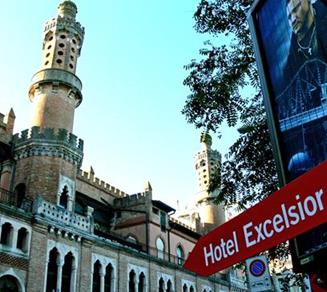
temporary, is the sentence passed for next year on the Excelsior Hotel, the Lido’s other palace for the plutocracy. It will
close for improvements. Look at the place, dear reader. Does it look as if it could be improved? But we mustn’t stay the
hand of history. All will be better in the best of all possible festival
islands. And by 2011 we will have swapped a cuckoo jury for a sane one. This
year’s delivered the most gaga prizes on record. The Golden Lion went to
Sofia Coppola’s SOMEWHERE – I haven’t changed my opinion, see paragraph 20 –
while the runner-up Special Jury Prize was handed to Skolimowski’s
ESSENTIAL KILLING (see paragraph 18), for which Vincent Gallo won Best Actor.
Best Actress went to Ariane Labed,
playing the alienated daughter of a dying architect in Athina
Rachel Tsangari’s Athens-set ATTENBERG, which is,
in essence, SOMEWHERE done as whimsical Greek tragedy. With howling injustice
China’s THE DITCH and Japan’s NORWEGIAN WOOD went prizeless,
while Russia’s SILENT SOULS was fobbed off with Best Cinematography. (Nice
hands, dear). Yes, we definitely need
a better jury or jury president. Get me Henry Fonda. Or alternatively get me
last year’s jurors, who not only nailed the Best Film – LEBANON – but got
every other prize right. As befits a team led by Quentin Tarantino, this
year’s jurors were inglourious basterds.
Another Adriatic hurricane such as the one on the first day will deal with a
similar jury if picked again. In the meantime, book my
gondola for 2011. It is the 150th anniversary of Italian
unification. It will be the party to end all parties. Viva L’Italia. Viva Garibaldi. Viva la Mostra. COURTESY T.P. MOVIE
NEWS. WITH THANKS TO THE AMERICAN
FILM INSTITUTE FOR THEIR CONTINUING INTEREST IN WORLD CINEMA. ©HARLAN KENNEDY. All rights reserved |
|
|
|
|
|
||




![Description: Description: Description: Description: Description: Description: Description: Description: Description: E:\HK\HK OFFICIAL PICTURE - LARGE & SMALL\HK[1].jpeg](VENICE_2010_files/image019.jpg)