|
AMERICAN
CINEMA PAPERS
2009
THE 62ND CANNES FILM FESTIVAL –
2009
TARKOVSKY
– A THOUGHT IN NINE PARTS
|
ALL THE WORLD’S A SCREEN by Harlan Kennedy For any film
fan it was a sprocketful of miracles.
Twelve days of cinema obsessed with cinema. The 2009 Yes: movies about movies. Films that use cinema as background
enrichment, integral plot or explosive historical catalyst (INGLOURIOUS
BASTERDS). Nearly all the directors were at it, though principally and most
inventively Pedro Almodóvar. Marco Bellocchio and the Basterd d’Honneur
himself, Q. Tarantino. Is it an
accident that 2008 and 2009 are centenary years? Ten decades ago in Bellocchio’s
VINCERE is full of the excitement of early cinema, of an era when celluloid
began to germinate, in the seedbed of popular culture, not just as an
entertainment mode but as an instrument for political propaganda. Many scenes in VINCERE are set in movie
theatres, where newsreels and patriotic films are like lightning storms
agitating public conciousness. In one
scenic tour de force, Bellocchio sets two opposing political
factions each others’ throats in an
auditorium, their silhouetted affray – filmed as if from the back of the
stalls – mimicking the chiaroscuro ballet flickering above their heads. Later in the
movie Mussolini himself towers on black-and-white screens, his lordly and
preposterous chin jutting up, like some mad punctuation point, at the end of
each fiery phrase in his rallying speech.
It wouldn’t work on TV, this dementia de grandeur. But TV hadn’t been popularized. Back then the audiovisual image was
gigantic, elevated, mythmaking. Tarantino
honours cinema with similar powers – or by means of symbolic fantasy even
greater ones in – INGLOURIOUS BASTERDS.
Here the French Jewish girl (Melanie Laurent) who escapes the Nazis in
scene one survives to take over and manage a Here the
explosive potential of nitrate film, helpfully explained to us in a
half-minute lecturette shoved into the narrative by Tarantino (nice
Dada-Brechtian touch), is employed to blast the Third Reich basterds to hell.
By this point Tarantino’s movie has become at once uncontrollably surreal and
unrestrainedly gung-ho, a mixture as unstable as the pile of celluloid behind
the screen which waits to be ignited.
At Pedro
Almodóvar’s BROKEN EMBRACES completed a triptych of films that made love, in
differing fashions, with filmmaking.
Here the entire plot revolves around a movie; and not just the feature
film that is in production and its maker (Lluis Homar), but the ‘making of’
film being shot around it by a creepy young man (Ruben Ochandiano) who may be
the product of another kind of ‘making of’. Whose son is he? Where does he come from? Is he, in the
technical rather than Tarantino sense, a bastard? What does he want? In the
magnetic force-field that is a movie set, the fictive and melodramatic
actions performed for the camera infect the ‘real’ actions done by people off
camera. Or is it the other way about? Either way, BROKEN EMBRACES proposes a
world where humanity is welded to its fantasy life and to emotions enriched
or elaborated by the templates we see in fiction. One could argue – and more than one Yes, cinema
was everywhere and everywhere was cinema. Sometimes for good, sometimes for
bad. Lars von Trier got hooted for
dedicating, in the film’s end credits, his blood-drenched metaphysical
shocker ANTICHRIST to Andre Tarkovsky.
Did he think the film was Tarkovskian? Wish on.
And the spirit of Buster Keaton, like lettering running through
seaside rock, permeated the gnomic Israeli comedy THE TIME THAT REMAINS,
whose director-star even looks like Old Stoneface, though he has a long way
to go to match the skill and insouciance of his ancestor’s gags. More beguiling
were As for the
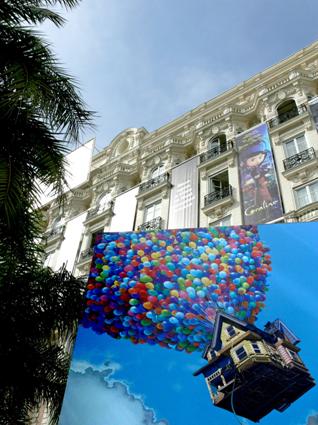
digimation extravaganza that launched Cannes 2009, it begins in a glory of
pastiche work. Spoof-recreating a
pre-war ‘Movietone News” item, UP takes us all – even those too young to have
been there before – to the days when screens were big, burbling and in black
and white. Lobbing graphics with the
zest of VINCERE, it honours a heyday long gone from the cinema but never from
the hearts of those who grew up with it.
Back then, giants stalked the magic light-patch called a screen. It seemed a world of enchantment even when
the giants were real, and when the beanstalk of magic that was an evening at
the movies had sherpa’d us only as far as the newsreel. Even from those
reality altitudes we got a dizzy view.
For that was cinema, and in the giant screening spaces of COURTESY T.P. MOVIE NEWS. WITH THANKS TO
THE AMERICAN FILM INSTITUTE FOR THEIR CONTINUING INTEREST IN WORLD CINEMA. ©HARLAN
KENNEDY. All rights reserved |
|